

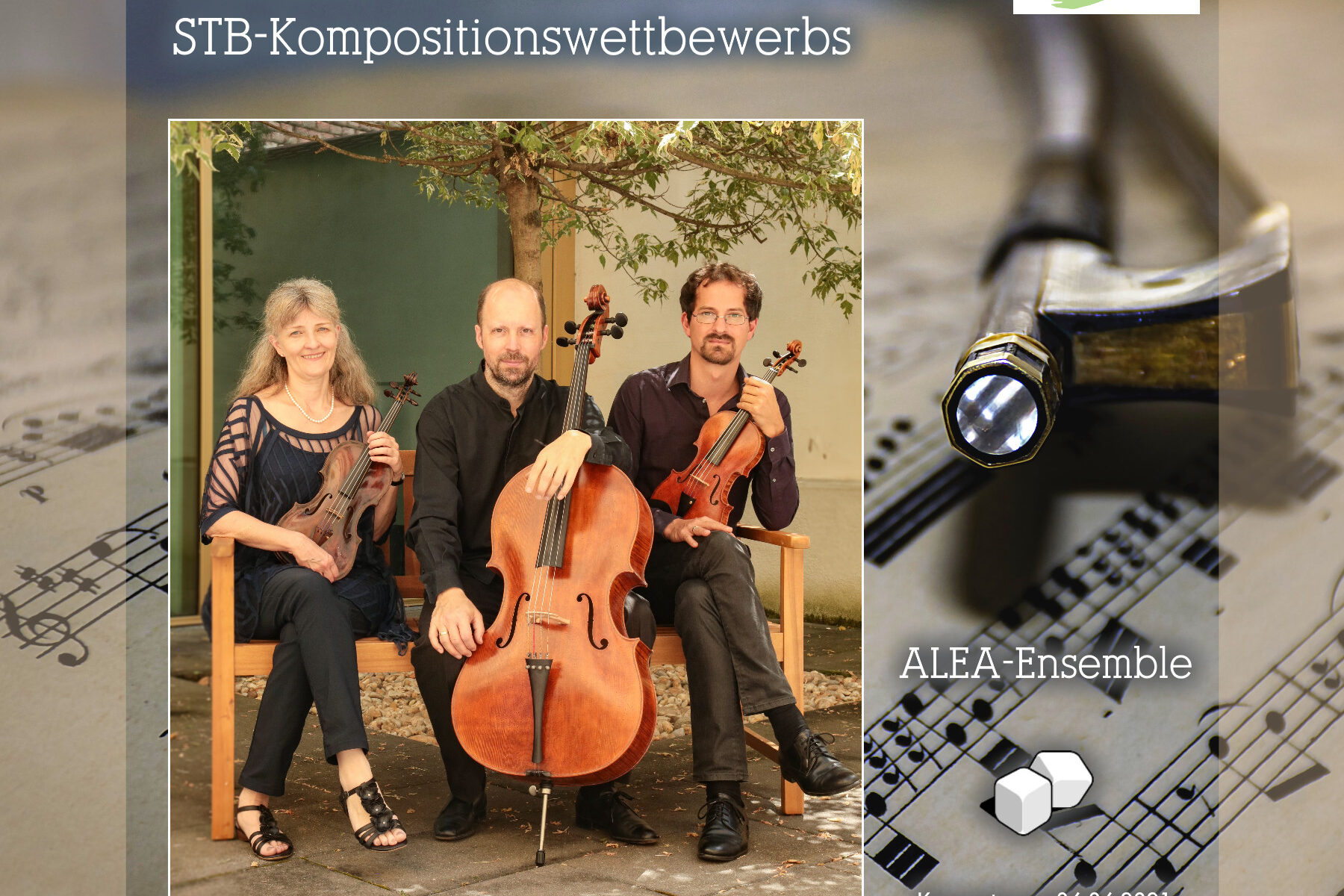
Following my recent award, I have given an interview for the Mitteilungen des Steirischen Tonkünstlerbundes.1 I am pleased to share it here.
Gerhard Präsent: Dear Stefano, my congratulations to you for winning the second prize at our international composition competition, and it was very close indeed (1 point) to the first prize! Could you please tell our readers something about your musical origins … were there any professional musicians in your family?
Stefano Gioffré: Thank you, Gerhard. It was an honour for me to win this prize. I grew up in a small town in southern Italy and I come from a middle-class family with no professional musicians. For unexplainable reasons a lot of musical instruments have always circulated around in my childhood house. That, and the fact that my parents have always been very supportive, have created the right conditions for me to study music.
GP: You studied first in Rome, but you’ve also been in Graz for some time … later you went to England. Who were your teachers—and how could you describe your studies with them?
SG: My teachers were all very different from each other. My first composition teacher was Mario Scappucci, in Reggio Calabria, when I was still a teenager. Although it was a short experience, I completely owe him my infatuation for composing. He was captivating, able to link the most disparate areas of human knowledge, and show that composing is a total-approach to life—it was my imprinting. Then I enrolled at the Conservatory of Santa Cecilia in Rome, where I studied with Francesco Telli. He was a very strict teacher, who demanded a lot of training from his students, and was incredible in creating a school. Severe, yes, but with all the right intentions. I was not a teenager anymore, and the relationship with him was more formal and detached. It was with him that I learned that composing is continuous research, in which we must never get satisfied too easily. It was also impossible to talk to him without having done a fair amount of work beforehand—and only then, in front of a score, a few words were possible (but still not too many). From that I have learned that conceptual art can be fascinating, but with composition it better remain as an emergent element and only very occasionally stand up as the leading one. Especially during a formative period, there is indeed a big risk that concepts might constitute only rationalizations that we create to fool ourselves. And since I always loved concepts, I learned to pay attention to them.
Towards the end of my studies in Rome, I did a course with Salvatore Sciarrino at the Chigiana Academy in Siena. It was a very intensive course, which occupied the entire mornings, afternoons, and evenings of almost an entire month. I have very good memories of that course. There I met wonderful musicians, and Sciarrino is a composer hard to forget. It was challenging for composing though—Siena in summer is anything but a silent place—but in the end I managed.
After an Erasmus at the MDW in Vienna with Detlev Müller-Siemens I studied in Graz with Beat Furrer. The experience with Beat was touching for me. By then I already had my ideas quite clear. From outside it could seem that our musical interests would not overlap, and yet they did, in unusual ways. The first thing I noticed about Beat is that he is an enthusiast. I love enthusiasts. Even the strongest advocate of Adorno’s negative aesthetics can never be that negative if they are an enthusiast. Beat has an incredible culture about classical and contemporary music, and I found he loves almost all of the things that I love, too. We would often travel back to Vienna together and talk about music the whole trip. I am still very fond of those memories.
At last comes my doctorate. A doctorate has this scary peculiarity in that the person who does it must convince the world that something the world does not care about should be cared about. Thus, a doctorate is basically a perversion, or an obsession, or both. I owe Roger Marsh and Thomas Simaku a big thank for believing in me in this crazy adventure.
GP: Which composers have been the most important influences for you in the past and in the present—and why? What do you admire among them?
SG: In no particular order: Brahms, Schumann, Vivaldi, Nono, Rossini, Beethoven, Berio, Stravinsky, Mozart, Mendelssohn, Schönberg, Sciarrino, Schubert, Petrassi, Debussy, Ligeti, Verdi, Cage, Purcell, Bach, Mahler—the list can go on and I probably forgot many. But the reasons would be a really long list!
GP: How would you describe your compositional style … what are the musical languages you use … what is the goal of your compositions—and what do you want to achieve with it eventually?
SG: I have heard the most different answers to these questions. Some composers are in search of themselves, their identity, through music. I would have loved if that had been my motivation, but I have always had the opposite necessity. I have always felt that my identity is too strong, and periodically needs to find its way out, dilute itself into something else, or just get out of the way. I don’t think that my compositions have any particular goals external to the music itself, but I do have goals as a composer living in this world, and that is probably visible in my pieces.
They definitely have an identity. It would be more correct to talk about my compositional approach rather than style; style is only a dress and can change easily with me, especially considering that as soon as I master something it becomes me, and I have to get rid of me. My approach is a bit like that of a magnet, which attracts and piles up every piece of iron it finds in its way. It is an inclusive approach, where different dimensions live together and form layers.
GP: How do you start a new piece? What’s the starting point? Are you working quite fast … or does it take longer to finish a new work?
SG: The starting point can vary. Sometimes a soundscape slowly accumulates unconsciously in my mind in the previous months, and then composing ends up resembling the act of recalling a faint memory. Other times it is only me and the unknown, and in that case creation has more similarities with the idea of pure research. As for the speed, it can go either way, and mostly depends on how safe I feel at focussing on composing without worries.
GP: Your winning piece “A Kid’s Guide to the Sunrise” is kind of a Tarantella, very much loved by the audience in Graz. On the other hand you studied shortly with Beat Furrer in Graz, who prefers quite a different style of music, as far as I’m concerned. How would you explain the Tarantella to Beat Furrer?
SG: I did show him the piece, actually. We did not spend much time on it, I was fully concentrated on writing a lyrical opera back then, but I remember that he liked it. I remember him giving me suggestions about the rhythm.
GP: What do you think about the present gap between contemporary composers … and the broader audience who is interested in classical music. Many are simply afraid of new pieces, often being hard to understand, off-putting and not enjoyable … in many cases this might be quite justified.
SG: That is literally the topic of my PhD—and that means that I could spend tons of words on it (so I’d better not). To make it short, it might not be the problem that we would like it to be—although personally I can hardly stop thinking about it. We live in an epoch where “post-truth” was declared by the Oxford Dictionaries as the international word of the year in 2016. That word, as Sean Illing put it, simply means “the disappearance of shared objective standards for truth”.
Concretely speaking, post-truth is that phenomenon that explains why many Trump voters could hardly believe that so many people voted for Biden, and the same goes for Biden’s voters, who could hardly believe that so many people voted for Trump. The two groups simply did not interact with each other. They did not meet in the same streets, they did not attend the same events. This is the era we live in.
Today’s music listeners don’t normally search for unifying concepts, and our era feels at ease with fragmentation, or at least tolerates it quite well. Who listens to contemporary music today does not feel like a privileged individual who is a step forward compared to others in some path towards “the big truth”—as it could have maybe been years ago. And that feels just fine. As composers, we must be aware of this.
Personally, I do not believe it is a natural tendency. I think it is the result of the impossibility to comprehend today’s world in all its complexities—the human brain per se would rather be constantly in search of unifying concepts; after all, finding patterns is one of the things that characterize us.
When I started my PhD, the idea was to explore a possible solution: that of moving a bit of this complexity away from the audience’ shoulders and putting it into the composers’ hands, and searching for a musically inclusive, rich, and layered approach—or at least always keeping a door open for it—without renouncing to experiment.
Some composers explicitly ask for the opposite. Sciarrino for example introduced the concept of “listening ecology”, whereby he asks the audience to make an effort before approaching a new piece, to get rid of all its past cognitive grids and prepare some fresh ears necessary to enjoy the novelty. That sounds to me like the dove in Immanuel Kant’s metaphor, which feels the air resistance while flying and thinks “How much faster would I fly if there was no air!”.
Listeners’ grids, their past experience, are not just something necessary like the air and the wings for the bird that flies, and they do not just constitute a casual enrichment of the composer’s message when it reaches a listener: they have the power to represent a constant element of reflection for composers, who thanks to them can keep wondering about where they are and why: they literally are “a dialectic pole”.
The sensitivity towards this in my opinion has some similarities with the concept of empathy in psychology. Empathy is not simply that naïve quality that makes a person kind, it is much more than that: it shapes the entire way of thinking, it opens new cognitive paths, and it even influences the way in which we memorize the world. But exactly like empathy, being affected or not by the dialectic between “poetics” (i.e., what composers think they are doing) and “aesthetics” (i.e., what listeners can understand) might simply be hard-wired to our personality. I am sure that trying to find answers to these questions can bring interesting outcomes.
GP: At our competition we asked in advance for “attractive pieces to the audience”—and the listeners could participate in the final judgement, quite to your benefit. Do you think of the audience when writing a piece—or do you just compose what and how you like?
SG: Only two years ago I would have probably not been able to answer this question. Today maybe I can try. I do think about the audience, of course; but I do not think about it more than I think about myself. Probably the order of who I want to please the most when I compose would be 1) myself 2) the performers 3) the audience—so the audience would not even come second in the list. That said, by character I am instinctively permeable to everything that surrounds me—which builds up and accumulates in me—so, unintentionally, the audience does come back strong eventually—but filtered, second hand.
GP: I often think that it should be possible to include at least one work of a living composer in each and every classical concert, but most programs are filled with classical/romantic repertoire only, and contemporary works are mostly performed in “special” concerts (if at all) … and to an audience of specialists, often composers of a similar aesthetic. This is a great pity. I think it would be a positive challenge for any composer to see if a new composition can stand up in a program against traditional masterworks. Your opinion?
SG: It took centuries for theatre to understand that the audience needs to be “warmed up” before being able to pay attention. And when it finally did, all sorts of comical sketches where inserted between the acts of tragedies—we have lost so many useful practical skills with modernity… Believing in a rich and inclusive approach persuades me that different repertoires can resonate in unexpected ways. But being able to find the right combinations is an art, and it might just be a forgotten art. Both worlds (classical and contemporary musicians) don’t help in finding a solution, and are often happy ignoring each other. This difficult situation shows even more clearly the advantages of building bridges.
GP: What can we do to initiate a change for the better? The market for CDs is suffering … videos on “youtube” rarely receive more than 1000 views … and the composers earning nothing at all. Do you think the internet with all its social media possibilities can be a great help for composers?
SG: Indirectly yes, internet and social media allowed composers to create connections they would have struggled to create in the past, and that was a wonderful thing. I do not think though that they directly opened new ways to secure a career, which especially after COVID has become as hard as ever for composers. We create culture, and yet we often struggle to find the motivations to exist. Personally I believe that only public funding could bring some fresh air. No one should be left behind, even those who are among the least interested in softening the current gap between composers and audience should survive and be free, because everyone has something to say, and each of us might be wrong after all.
GP: Do you start a new composition when you feel an inspiration—or do you receive commission for new compositions—by concert organizers … or by musicians?
SG: Mine is still a small world, but in my small world, all three.
GP: What are your plans for the nearer—or farther—future? Any new works in sight?
SG: I have some backup jobs at the moment, and my hope is to remain in academia. I have always loved to teach and do research, and teaching composition would literally be a dream. It is a hard goal to achieve, but I have hope.
GP: You just graduated as a “doctor” in Great Britain. Tell us some details about that.
SG: This doctorate has been an intense path for me, and I am not sure I am already able to define all its meanings. I did not graduate yet, I am in my final submission months.
GP: What is your major occupation besides composing? What do you make for a living, especially in these hard COVID-times?
SG: Right now, I am back in England, concentrating on submitting my PhD. During the worst times of the pandemic I spent several months in isolation in a house by the sea in Italy, and right before COVID I was teaching at my department at the University of York. For the immediate future I plan to teach in a school and keep applying wherever opportunities show up.
GP: What kind of music do you enjoy to listen to … privately, when you are not “working”? Any other hobbies?
SG: When I am alone, I listen almost only to classical and contemporary music. It is very refreshing, because when I work, I can only listen to myself. I love dedicated radio channels, where I often discover pieces I never suspected existed. My most recurrent hobbies are playing the violin, reading, and trying to stay healthy.
GP: Thank you very much—and all the best to you. We would love to welcome you in Graz again!
Notes
- Präsent, Gerhard (October 2021). “Interview with Stefano Gioffré” (PDF). Mitteilungen des Steirischen Tonkünstlerbundes (43) [alternative link]: 36–41. ↩︎