

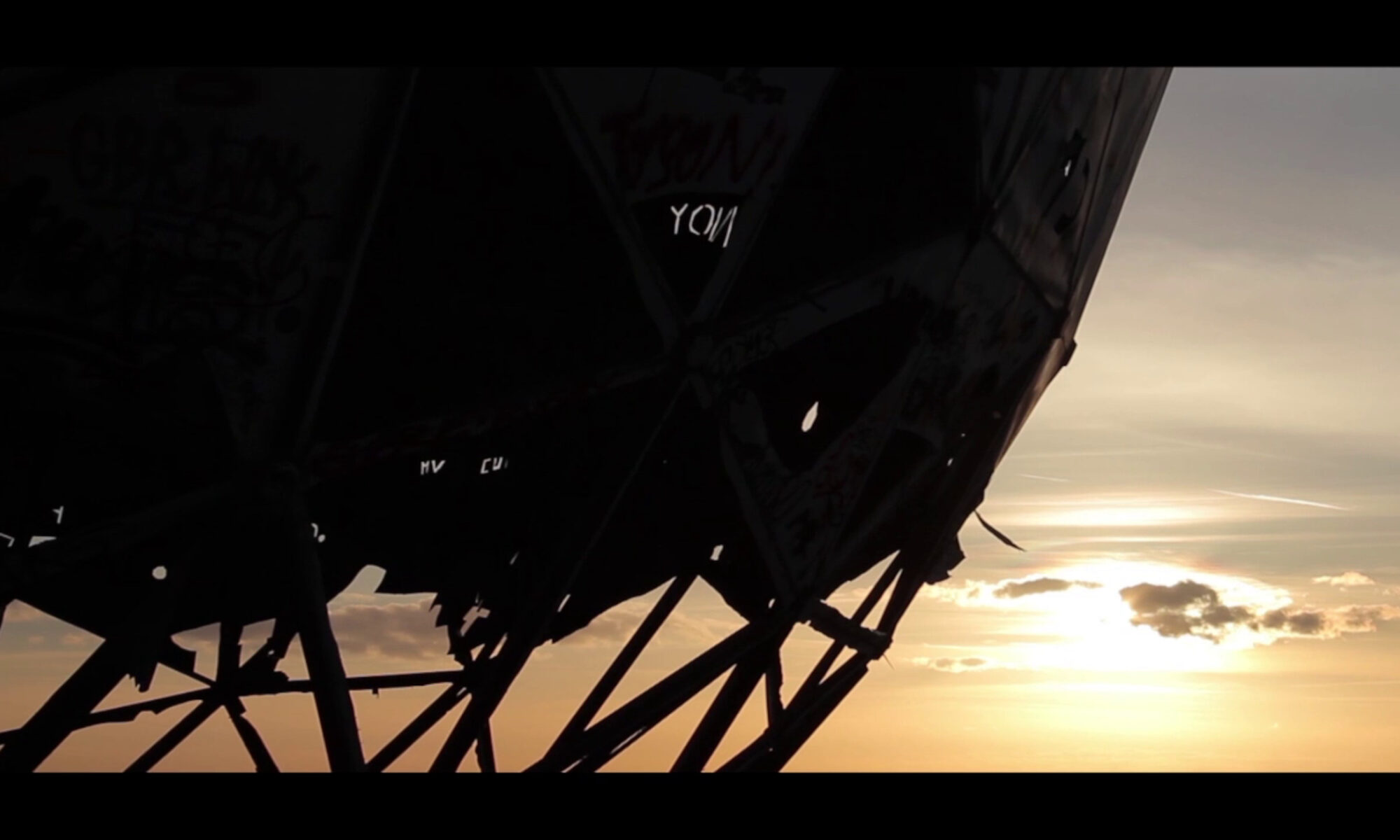
Sometimes, collaborations work out effortlessly, driven by pure and natural chemistry. Other times, they’re more like a leap into the void—they are filled with uncertainty, doubt, and risks until the very last moment. The short film Nowhere definitely belongs to the second category: a collaboration that was built on the willingness to take risks and the hope that everything would eventually come together in the end.
The project emerged from “contro Spazio Visual”, an initiative organized by the Conservatory of S. Cecilia and the Centro Sperimentale di Cinematografia to bring together composers and filmmakers from the Eternal City (I would like to thank Maestro Francesco Telli for proposing me to the event).
There I discovered Francesca Mazzoleni—the film director—and her passion for Berlin. For this project she had decided to document the abandoned listening station of Teufelsberg, in West Berlin, and her enthusiasm was contagious from the start.
Getting the job done however was particularly challenging for us; Francesca and I live in completely different cities—she is based in Italy, and I have recently moved to Vienna. Our communication was limited to videocalls and emails, and our ability to influence each other’s work was constrained by distance.
For me, the project was daunting also because I had never written music for a film director before. And so even the little things, like showing Francesca what I was creating, were challenging. I’ve never been a fan of fancy MIDI libraries, and moreover the music I was composing required peculiar sound effects that were difficult to replicate through digital instruments. As a result, the only thing I could send her was a horrible MIDI file, and not before we were almost ready to put all the pieces together.
Looking back, I can only imagine how petrified Francesca must have felt after listening to that synthetic mock-up. Had I been in her shoes, I would probably be filled with doubt and hopelessness. It’s not just that it wasn’t the smooth, finished product one might expect from a composer: if that were to be the final result of months of work, the project would be a complete disaster and an utter failure.
That is why I distinctly remember the smile that spread across her face when we finally came together to rehearse with live instruments. That moment—hearing the music come to life with real musicians—was priceless, and I could feel her palpable relief. That was the real turning point in the project.
The first thing that makes Nowhere interesting is the fact that the music was performed live by the PMCE ensemble, and synchronized with the images during the concert at the Parco della Musica auditorium in Rome (an exception is the presence of the Apples in Space performing their music within the film—this one is recorded in the video and not part of the live concert).1 There was no way for us to see how things would work together until… they did on stage. Afterward, we used that live performance as the soundtrack for the final video, without needing to do a second closed-door recording. For this part Alessio Franco deserves a lot of praise for his talent in film editing.
Nowhere is hard to categorize. The music is too abundant for a documentary; The documentary is too present for a music video. Probably in the end Nowhere is more than just a film or a piece of music: it is an experiment in both directions at the same time. But for me and probably Francesca too, more than anything else, it was ultimately a leap into the void—a testament to the power of trust, collaboration, and perhaps a touch of sheer luck. Without the willingness to take risks, to embrace uncertainty, and to work together across distances, it never would have been the good short film that came out. And for that, I’ll always be grateful to Francesca for taking that leap with me.