

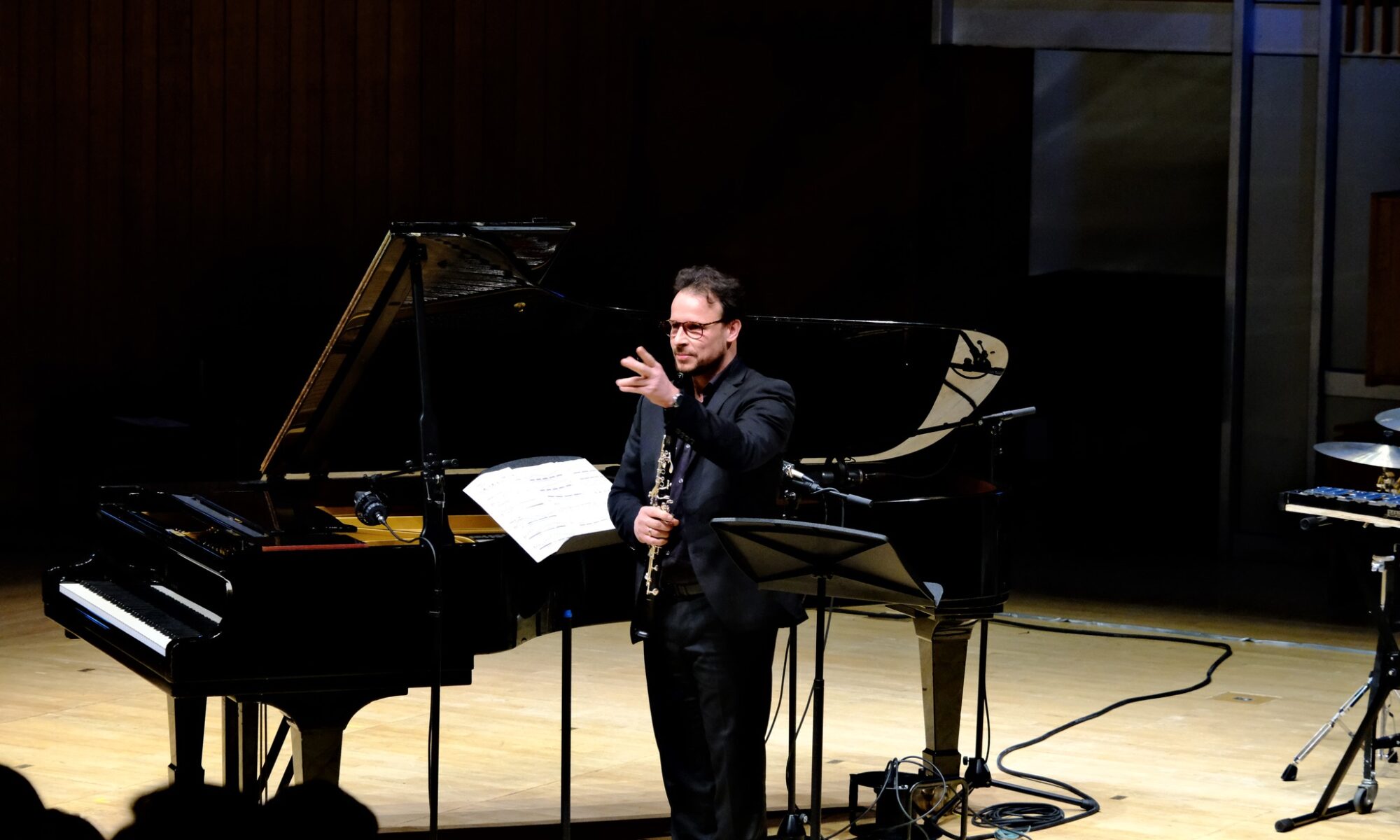
In the intimate yet powerful acoustics of the Sir Jack Lyons Concert Hall, something extraordinary happened this week. Jérôme Comte, a truly gifted soloist and a member of the renowned Ensemble InterContemporain, performed my piece La réponse est dans la pelote de laine for solo clarinet. What an experience! There are rare moments in a composer’s life when an interpretation feels so complete, so in tune with the essence of the piece, that it seems almost impossible to improve upon. This was one of those moments.
The title of the piece, which translates to “The Answer is in the Ball of Wool”, evokes the image of a cat absorbed in play. It does not stand as a literal “programme”, but rather as an analogy. A cat playing with a yarn ball pushes it, rolls it, animates it. Yet, despite its loneliness in the game, the cat can become so immersed that it begins to perceive the yarn as a living entity, a prey to be hunted. Occasionally, an unexpected moment occurs: the ball might teeter on the edge of a surface, momentarily existing in a state of instability. It may even move unexpectedly, startling the cat as if it were truly alive. This transformation—where an object animated by an external force suddenly appears to have its own agency—is at the heart of the piece.
At its core, La réponse est dans la pelote de laine is an exploration of what I call “negative energy” and “volatility.” These concepts, which I explore in my research, inform the way sound and gestures unfold within the piece. The performer, much like the cat, injects energy into the system, shaping its motion and controlling its momentum. But the volatility of the material—the way sound decays, the fragility of certain musical gestures—allows for moments where control seems to slip, where sound itself almost becomes an independent force.
Jérôme Comte embodied this delicate interplay with breathtaking precision and sensitivity. His performance was not just an execution of notes, but a genuine engagement with the volatility embedded in the music. Each phrase carried a delicate balance of control and release, intention and unpredictability. It was a privilege to witness, and I could not have asked for a more insightful interpreter.
Moments like these remind me why I compose—to explore sound, to create these fleeting but intense experiences, and to collaborate with performers who bring music to life in ways beyond what I could have imagined.
For those interested in the underlying ideas of negative energy and volatility, I invite you to explore my research further. But ultimately, the real answer—the true réponse—was in the concert hall that evening, in the resonances of Jérôme’s masterful performance.
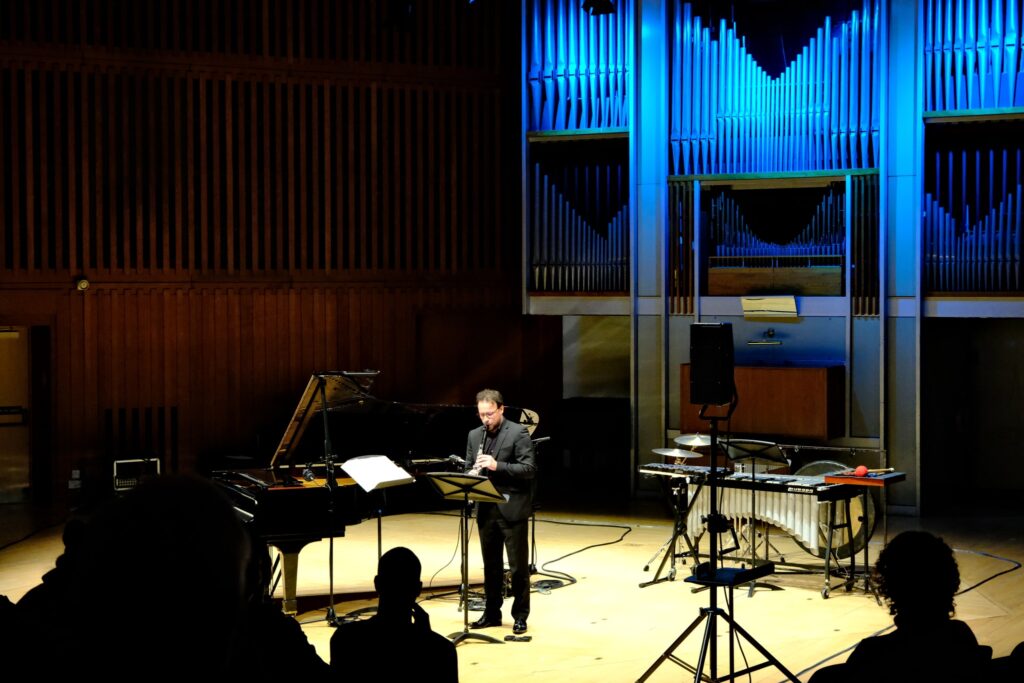
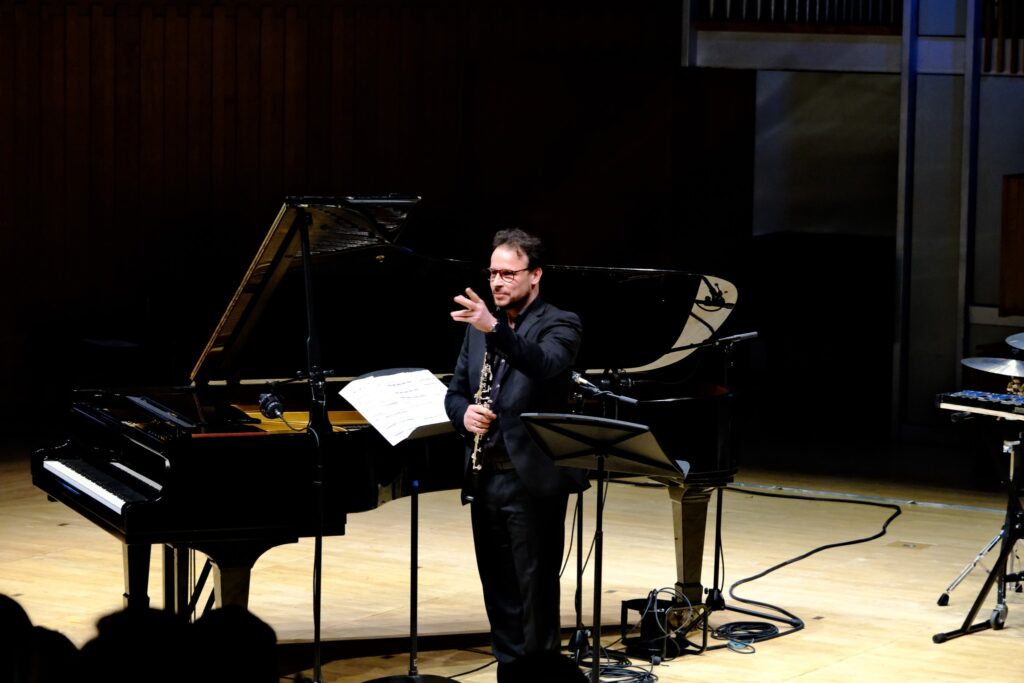
Here are some photos of Jérôme, kindly shared by Prof. Thomas Simaku, taken during the performance of Simaku’s piece Soliloquy VII for Clarinet in B♭ with resonant piano (2020).
Read also: York Academy (posted by the Ensemble Intercontemporain), and New music by York students performed by Ensemble Intercontemporain (posted by the University of York).